Is it ready yet?
The Commonware Library is now home to 17 primitives and over 50 primitive dialects (cryptography::bls12381, cryptography::ed25519, etc.), with 93% test coverage.
The only number that probably matters to you, however, is how many primitives are ready to use.
Today, we are sharing our approach to versioning, explaining how we enforce consistent stability with the compiler, and (most importantly) graduating a large number of primitives to BETA.
Solving a “Solved” Problem
The obvious approach to tracking stability is semantic versioning: break each
primitive into its own crate, use 0.x for unstable
and 1.0+ for stable, bump major versions for
breaking changes, and gate experimental features behind an
unstable flag.
While building with different teams, however, this approach proved insufficient:
Compatibility is unclear. With many crates
versioned independently, it is not clear what combinations have
been tested together. [email protected]
“should” work with [email protected] if it
compiles. In a world where a wrong guess means a network halt or
loss of funds, however, we found this didn’t cut it.
Coarse readiness slows development and is error-prone for applications. Without more granularity, new features tend to sit in “unstable” purgatory for too long. When incorporated into downstream applications, all of “unstable” is available making it easy to accidentally rely on something much less stable than intended (with nuance hidden deep in documentation that nobody reads).
Long-Term Support is not apparent. We take a
Linux-like approach to stability: once something is marked as
“stable,” it must remain supported indefinitely. If we need to
make a significant change, it must be backwards-compatible or
introduced in a new crate. There is no 2.x for a
primitive.
Tiered Stability and Calendar Versioning
We’ve broken stability into the following levels:
| Level | Index | Description |
|---|---|---|
| ALPHA | 0 | Breaking changes expected. No migration path provided. |
| BETA | 1 | Wire and storage formats stable. Breaking changes include a migration path. |
| GAMMA | 2 | API stable. Extensively tested and fuzzed. |
| DELTA | 3 | Battle-tested. Bug bounty eligible. |
| EPSILON | 4 | Feature-frozen. Only bug fixes and performance improvements accepted. |
Once a primitive is marked BETA, it is eligible
for Long-Term Support (LTS). Barring any critical
vulnerabilities, the wire and storage format will remain
backwards-compatible indefinitely.
For compatibility, we also needed to rethink our versioning
scheme. The Commonware Library now uses calendar versioning
(YYYY.M.patch). This provides obvious compatibility without
implying stability (a library-wide semver like
1.2.1 would incorrectly suggest that every crate,
including brand-new ones, is equally mature).
Programmatic Enforcement
Every public object in the Commonware Library is annotated
with a stability level using proc macros that expand to
cfg attributes.
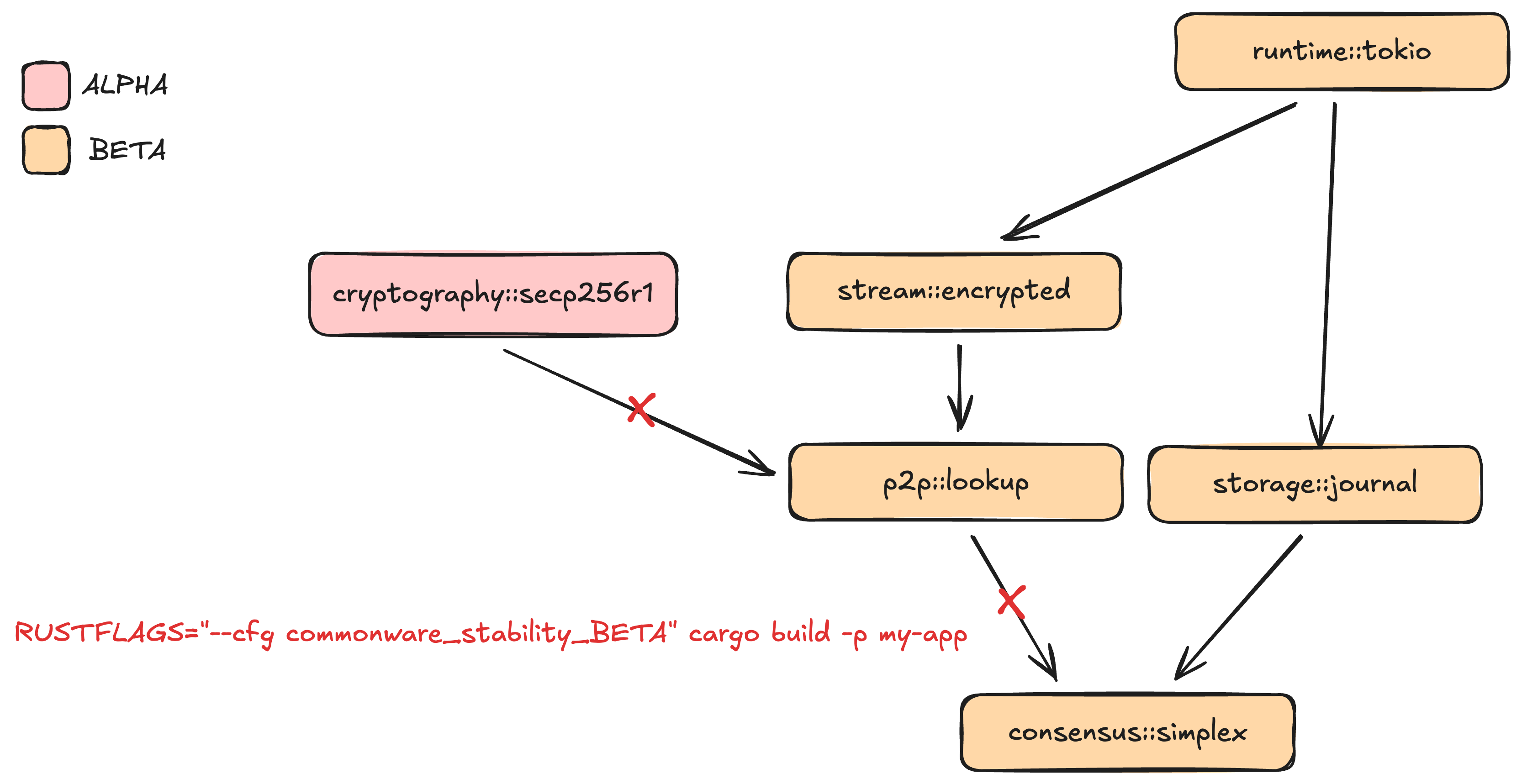
Set your minimum stability level once via
RUSTFLAGS and it applies globally:
RUSTFLAGS="--cfg commonware_stability_BETA" cargo build -p my-appIf your code depends on an ALPHA API, it won’t
compile. No runtime checks. No documentation to read. The
compiler tells you.
You can also filter rustdoc to show only APIs at your desired stability level:
RUSTFLAGS="--cfg commonware_stability_BETA" \
RUSTDOCFLAGS="--cfg commonware_stability_BETA" \
cargo doc --open
We also enforce stability transitively in CI: any object must
only depend on objects at the same or higher stability level. If
something is marked BETA, its entire dependency
chain within the library is BETA or higher.
Graduation Day
Here are some of the primitive dialects we now consider
BETA (eligible for LTS):
- codec - Serialize structured data.
- runtime::tokio - A production-focused runtime based on Tokio with secure randomness and storage backed by the local filesystem.
- parallel::rayon - Parallelize fold operations with Rayon.
- math::poly - Operations over polynomials.
- cryptography::ed25519 - Ed25519 signatures.
- cryptography::bls12381 - BLS12-381 multi-signatures, DKG/Reshare, and threshold signatures.
- stream::encrypted - Encrypted stream implementation using ChaCha20-Poly1305.
- p2p::authenticated::discovery - Communicate with a fixed set of authenticated peers without known addresses over encrypted connections.
- p2p::authenticated::lookup - Communicate with a fixed set of authenticated peers with known addresses over encrypted connections.
- broadcast::buffered - Broadcast messages to and cache messages from untrusted peers.
- resolver::p2p - Resolve data identified by a fixed-length key by using the P2P network.
- storage::journal - An append-only log for storing arbitrary data.
- storage::archive - A write-once key-value store for ordered data.
- consensus::simplex - Simple and fast BFT agreement inspired by Simplex Consensus.
- consensus::marshal - Ordered delivery of finalized blocks.
Is It Ready for Production?
The Commonware Library isn’t battle-tested (yet). However, we are shooting for the “next best thing.”
From the start, we’ve prioritized robustness and testing
above all else. Our deterministic runtime
has allowed us to reach 93% test
coverage across the repository and 97%
test coverage in critical components (like
consensus::simplex).
For over 10 months, we’ve been running all BETA
primitives listed above in Alto. For the
last 9 months, we’ve been collaborating with Asymmetric
Research on fuzzing and manual
code review.
We have yet to mark any primitives as DELTA (bug
bounty eligible) but hope to do so in the coming months. In the
meantime, we welcome responsible disclosures via GitHub
Vulnerability Reporting.
Interested in helping us get to GAMMA,
DELTA, and EPSILON? We’re hiring for great
engineers (and offering significant equity).